

If you are looking for a lactose-free poke, the starting point is not just the base of the bowl. The most common doubts arise from sauces, toppings, and composite ingredients, elements that may contain milk or derivatives even when it is not immediately recognizable. A bowl may seem fresh and simple, but just one dressing or creamy topping can change the allergen profile.
Before going into detail, it is worth clarifying a distinction:’lactose intolerance is a digestive difficulty related to milk sugar, while milk protein allergy is a very different immune reaction. In both cases, this article does not provide medical advice: for specific needs, it is always necessary to consult a health professional and verify the official information of the product or point of sale.
Which poke ingredients are generally lactose-free
In the classic composition of a poke bowl, there are many ingredients that, in their basic form, do not contain lactose. Rice, fresh vegetables, raw fish, simple proteins like tuna, salmon, or chicken are generally free of milk or derivatives. The same applies to many plant-based bases and to fresh, minimally processed ingredients.
The situation changes when talking about:
- sauces and dressings, which may contain non-intuitive ingredients such as cream, butter, or milk derivatives in hidden form;
- creamy toppings, creams and dairy-based dressings;
- cheeses and dairy ingredients added as toppings;
- marinated or processed preparations, where the composition may include milk or derivatives without the name suggesting it;
- special or gourmet additions, often described briefly on the menu.
In other words: the more straightforward the bowl's composition, the easier it is to verify each element. The more processed ingredients there are, the more necessary it is to investigate.
Why just reading the ingredient name is not enough
One of the most common mistakes is relying solely on the name of an ingredient or a bowl to assess its composition. A sauce with an oriental name may contain milk derivatives; a crunchy topping may include butter among the ingredients; a marinade may hide elements not immediately visible.
For this reason, the advice is always the same: do not stop at the name, but check the full composition. In a format like poke, where customization is one of the strengths, this check is accessible and straightforward.
A useful reference is the allergen table: consulting it before ordering allows you to understand which ingredients contain declared allergens, including milk, and to make a more informed choice.
How to compose a lactose-free poke bowl: practical examples
Building a dairy-free bowl does not mean giving up taste or variety. It means choosing more consciously. Here are some example combinations that tend to be easier to verify:
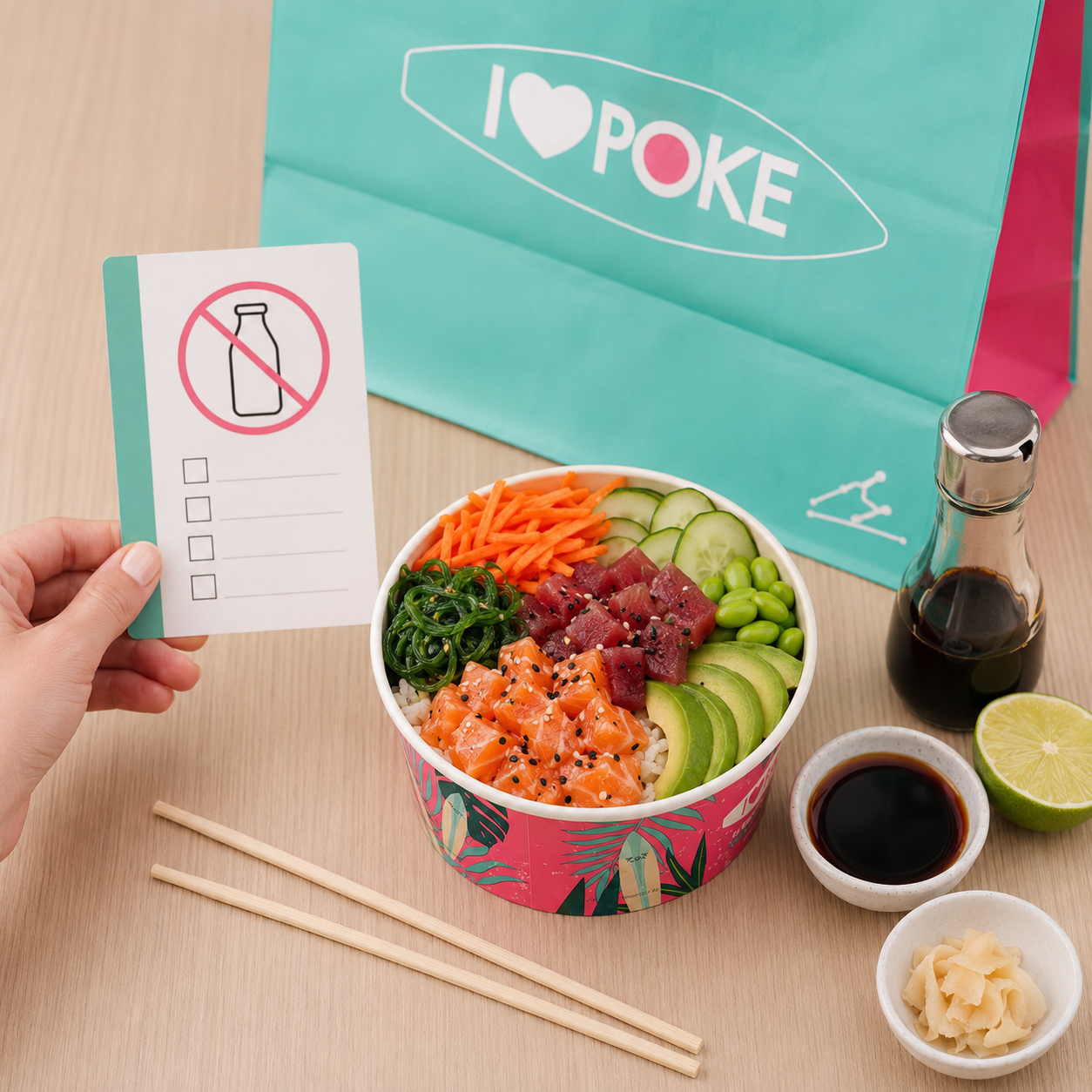
- Rice base + salmon or tuna + fresh vegetables + soy sauce or ponzu: linear composition, easily recognizable ingredients.
- Rice base + chicken + avocado + crispy onion + teriyaki sauce: watch out for teriyaki sauce, which in some recipes may contain ingredients to check.
- Green base (salad or brown rice) + tofu + edamame + sesame + sweet and sour sauce: plant-based composition, but sauces always deserve a check.
These are indicative examples: recipes and ingredient availability may change. Always check the updated composition and consult the official information of the point of sale before ordering.
Practical checklist before ordering a dairy-free poke
If you want to choose a lactose-free poke quickly and consciously, these steps can help you not to forget anything important:
- Check the complete composition of the bowl, not just the main ingredients.
- Carefully observe sauces and toppings: these are often the most delicate points.
- Do not rely only on the name of the ingredient or dressing.
- Consult the official allergen table before confirming the order.
- Prefer fresh and easily recognizable ingredients if you want to reduce doubts.
- Ask for confirmation at the point of sale when a detail is unclear or when you have specific health or allergy needs.
- Remember that recipes and ingredients can change: even if you have ordered a bowl before, it is worth double-checking.
When to do an extra check
There are some situations where it is particularly useful to stop and check more carefully:
- when a sauce is an integral and abundant part of the bowl;
- when a topping is described as creamy, special, or gourmet;
- when you are customizing the dish a lot by adding more elements;
- when you order at a location different from the one you usually visit;
- when the ingredient description is very brief and does not clarify the composition.
In these cases, the most useful reference is always to check the updated official information. The allergen table is designed precisely to address this type of doubt in a direct and transparent way.
Lactose intolerance or milk protein allergy: an important distinction
Although this article is not intended for medical purposes, it is useful to know that lactose intolerance and milk protein allergy are different conditions. Intolerance concerns the digestion of milk sugar (lactose) and can manifest with gastrointestinal disorders. Allergy, on the other hand, is an immune response to milk proteins and can have more serious consequences.
In both cases, the people involved must pay attention to ingredients and milk derivatives. Those with a confirmed allergy must be even more rigorous in checking every component of the bowl. For any clinical or nutritional doubts, the reference is always your doctor or specialist.
FAQ about lactose-free poke
Is a lactose-free poke always easy to recognize? Not always. The simplest ingredients are generally easier to evaluate, but toppings, sauces, and elaborate preparations may require closer verification. If you have doubts, always check the product sheet and the official allergen table.
Where are milk derivatives most often hidden in a bowl? Usually in dressings, creams, sauces, and toppings added at the end. Even when the base of the bowl seems straightforward, it is useful to check every element that completes the dish, especially sauces and creamy ingredients.
How can I order a dairy-free poke with more confidence? The most practical way is to choose a simple composition, add only clear ingredients, and carefully check sauces and toppings before confirming. If in doubt, ask directly at the point of sale.
Is it enough to read the name of the bowl or sauce to understand if it is dairy free? No. The name alone is not enough. For an informed choice, it is necessary to check the full composition and consult the official allergen table.
What is the difference between lactose intolerance and milk allergy? Lactose intolerance concerns the difficulty in digesting milk sugar, while milk protein allergy is an immune system response. They are distinct conditions that require different precautions. For any specific guidance, it is necessary to consult a health professional.
Do recipes change over time? Should I recheck every time? Yes. Ingredients and recipes can vary over time or differ from location to location. Even if you have ordered a bowl before, it is always good practice to verify updated information before each order.
Ordering a lactose-free poke should not become a complicated operation. With a bit of attention to the right elements — sauces, toppings, composite ingredients — and consulting the available official information, it is possible to build a bowl suitable for your needs without giving up the variety and taste that make poke a unique format.